Global Terrorism Database (GTD)
Quick answer: The GTD provides the most comprehensive global database of terrorist incidents with over 200,000 attacks from 1970-2020.
Next step
Already have the export?
Open a GeoJSON result in the browser to inspect its map and attributes before sharing or converting it again.
Format
CSV / Shapefile
Geometry
Point (terrorism incidents)
Coverage
Global
Resolution
Incident-level point data
About this dataset
University of Maryland's comprehensive database of over 200,000 terrorist incidents worldwide from 1970-2020.
The Global Terrorism Database (GTD) from the University of Maryland's START consortium is the most comprehensive unclassified database of terrorist attacks globally. It contains over 200,000 incidents from 1970-2020, with details on date, location, attack type, weapons used, target type, perpetrator group, number of casualties, and property damage.
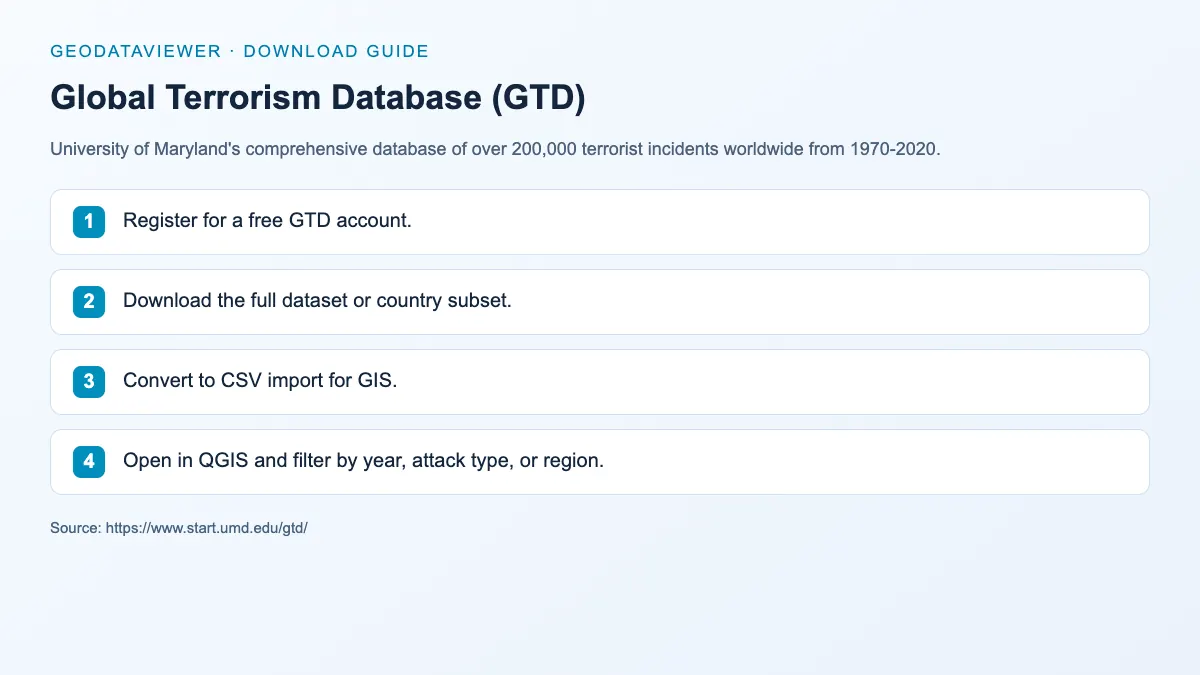
Download steps from this dataset’s GeoDataViewer guide. Follow the original provider for current files and access requirements.
How to download
- 1 Register for a free GTD account.
- 2 Download the full dataset or country subset.
- 3 Convert to CSV import for GIS.
- 4 Open in QGIS and filter by year, attack type, or region.
FAQ
How are terrorist incidents defined in the GTD?
The GTD defines a terrorist incident as an intentional act of violence or threat by a non-state actor to achieve political, economic, religious, or social goals.
What information is recorded for each incident?
Each incident includes 120+ variables including date, location (city, coordinates), attack type, target type, weapon type, perpetrator group, casualties, and property damage.