Global Human Settlement Layer (GHSL)
Quick answer: GHSL is the European Commission's global human settlement dataset providing built-up area and population grids at 30m–1km with multi-decadal epochs from 1975 to 2030.
Next step
Already have the export?
Open a GeoJSON result in the browser to inspect its map and attributes before sharing or converting it again.
Format
GeoTIFF / Raster
Geometry
Raster (built-up and population)
Coverage
Global
Resolution
10m / 100m / 1km products
About this dataset
European Commission's global built-up and population grids at 30m–1km, with five-yearly epochs from 1975 to 2030.
The Global Human Settlement Layer (GHSL) from the European Commission's Joint Research Centre provides global spatial information on human presence, built-up areas, and population distribution at multiple resolutions (10m, 100m, 1km). Release R2023A covers epochs from 1975 to 2030 in five-year steps, alongside products such as the Settlement Model (GHS-SMOD) and the Urban Centre Database (UCDB R2024A). Data is free to reuse with acknowledgement of the European Union.
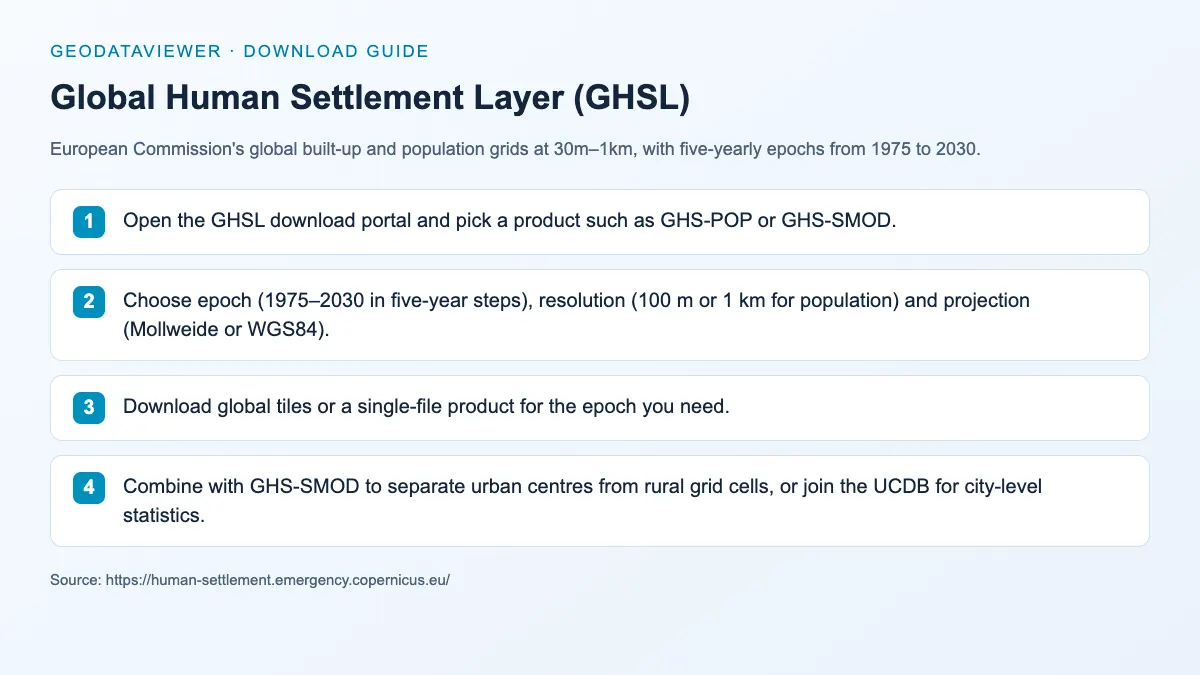
Download steps from this dataset’s GeoDataViewer guide. Follow the original provider for current files and access requirements.
How to download
- 1 Open the GHSL download portal and pick a product such as GHS-POP or GHS-SMOD.
- 2 Choose epoch (1975–2030 in five-year steps), resolution (100 m or 1 km for population) and projection (Mollweide or WGS84).
- 3 Download global tiles or a single-file product for the epoch you need.
- 4 Combine with GHS-SMOD to separate urban centres from rural grid cells, or join the UCDB for city-level statistics.
FAQ
What makes GHSL unique?
GHSL provides multi-decadal epochs (1975–2030) in a consistent framework, built-up area AND population grids, and multiple resolutions — ideal for long-term urbanization trend analysis.
Which resolutions are available?
Built-up layers reach 10 m; population grids come at 100 m and 1 km. Pick 1 km for global modelling and 100 m for regional work.
Can I use GHSL commercially?
Yes. The data is produced by the European Union and reuse is authorised with acknowledgement — cite the GHSL Data Package and the European Commission.